

.svg)

Beyond the counter: Why assisted self-service is shaping the future of banking
The future of banking is not about eliminating branches. It is about redefining their purpose.
Across the industry, financial institutions are reducing traditional branch footprints as customer behaviour continues to shift toward digital and self-service channels. The UK saw the number of bank and building society branches fall from 10,410 in 2019 to 6,870 in 2024, a decline of 34% in just five years. At the same time, digital banking adoption increased from 33% of consumers in 2020 to 59% in 2024.
In the United States, branch closures have occurred at a slower pace than many European markets, but the focus has shifted toward optimization rather than expansion. According to industry research, banks are investing in smaller, technology-enabled branch formats while reducing larger, transaction-centric locations. Many institutions now view branches as advisory and relationship centres, designed to support mortgage consultations, financial wellness discussions, small business banking and complex service interactions rather than routine transactions.
Yet despite the growth of digital banking, the branch remains an important part of the customer journey. Research demonstrates that consumers still value physical banking locations, particularly for complex transactions, financial advice and problem resolution. According to Accenture: Two-thirds (67%) of consumers like seeing branches in their neighbourhood as it portrays the stability and availability of their bank.
This creates a challenge for financial institutions: how can they reduce operating costs while maintaining customer access, trust and financial inclusion?
The answer increasingly lies in assisted self-service.
Moving beyond the traditional teller model
Historically, branch operations have been centred around teller counters handling routine transactions such as cash withdrawals, deposits, transfers and balance enquiries. Today, advances in banking technology enable more than 95% of these transactions to be completed through self-service channels, allowing customers to access banking services faster and more conveniently.
However, successful transformation is not simply about replacing people with machines.
Many customers still require reassurance when adopting new technology, particularly when handling cash transactions or more complex banking activities. Assisted self-service – whether it’s video assisted or in person via concierge - bridges this gap by combining the efficiency of automation with the confidence of human support. Rather than serving customers through a traditional counter, branch employees guide and assist customers in using self-service devices, creating a more engaging and educational banking experience.
The benefits of assisted self-service

For financial institutions, assisted self-service delivers benefits far beyond operational efficiency.
Firstly, it improves service availability enabling customers to complete routine transactions quickly, often outside traditional branch opening hours. This creates greater convenience while reducing queues and wait times.
Secondly, it accelerates customer migration towards digital and self-service channels. By receiving support during early interactions, customers become more confident using technology independently in the future. This helps drive long-term behavioural change while maintaining high levels of customer satisfaction.
Additionally, it allows branch teams to focus on higher-value activities. Instead of processing routine transactions, employees can dedicate more time to financial guidance, advisory conversations, customer education and relationship management. This transforms the branch from a transaction centre into a sales, service and advice hub.
Finally, assisted self-service supports financial inclusion. As branch networks evolve, human assistance remains available for customers who may be less digitally confident or have accessibility issues ensuring nobody is left behind during the transition to more technology-led banking.
For financial institutions, assisted self-service delivers benefits far beyond operational efficiency.
Reimagining access rather than reducing presence
Forward-thinking financial institutions are already embracing new operating models that balance efficiency with customer access. Shared banking hubs, collaborative ATM networks, micro-branches and technology-enabled service locations are helping banks maintain a physical presence while significantly reducing infrastructure costs.
The objective is no longer to maximise branch numbers. Instead, it is to maximise customer access.
As illustrated in our branch transformation eBook (Beyond the branch counter), physical banking is evolving into a connected ecosystem where digital channels handle everyday transactions, self-service extends availability, and human expertise is reserved for moments that require trust, advice and personal interaction.
The future branch
The most successful branch strategies will be those that recognise a simple truth: customers want choice.
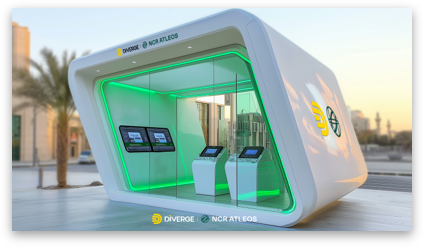
They want the convenience of digital banking, the accessibility of self-service, and the reassurance of human expertise when it matters most. Assisted self-service sits at the centre of this transformation, enabling financial institutions to reduce costs, improve customer experiences, support financial inclusion and create branches that are fit for the future.
In the next generation of banking, the branch is not disappearing. It is becoming smarter, more flexible and more focused on helping customers bank how, where and when they choose.
The most successful branch strategies will be those that recognise a simple truth: customers want choice.



Let’s explore what’s possible for your business. Our team is ready to connect and discuss tailored solutions that meet your goals.
Thank you for reaching out. A member of our team will be in touch shortly to continue the conversation.